Ulta Beauty: Designing for Sustainable Participation
Ulta Beauty: Designing for Sustainable Participation
Overview
Overview
A retail kiosk concept that makes recycling unused beauty products simple, rewarding, and scalable.
A retail kiosk concept that makes recycling unused beauty products simple, rewarding, and scalable.
role
role
UX Designer
Product Designer
Strategist
UX Designer
Product Designer
Strategist
tools
tools
Figma
Canva
Adobe Illustrator
Figma
Canva
Adobe Illustrator
focus
focus
Systems Thinking & Retail Experience
Systems Thinking & Retail Experience
platform
platform
In-Store Kiosk + Digital Integration
In-Store Kiosk + Digital Integration
THE STRATEGY
THE STRATEGY
Consumers feel bad about their consumption habits.
Consumers feel bad about their
consumption habits.
Overconsumption is a growing issue in the beauty industry. Consumers frequently purchase products they don’t end up using, leading to waste, regret, and unnecessary spending.
This behavior contributes to environmental harm, but it also creates a disconnect—people want to be more mindful, but don’t have easy ways to act on it.
Overconsumption is a growing issue in the beauty industry. Consumers frequently purchase products they don’t end up using, leading to waste, regret, and unnecessary spending.
This behavior contributes to environmental harm, but it also creates a disconnect—people want to be more mindful, but don’t have easy ways to act on it.
BACKGROUND
BACKGROUND
Ulta Beauty is the largest beauty retailer in the U.S.
Ulta Beauty is the largest beauty
retailer in the U.S.
Ulta serves a broad and evolving audience, with strong engagement from Gen Z and Millennials—groups that are increasingly conscious of sustainability, but still actively participating in beauty consumption.
Core audience: Women ages 16–25
Growing segments: Gen Z, Millennials, and younger male consumers
Behavior shift: Beauty is becoming more expressive and routine-driven, increasing purchase frequency
Ulta serves a broad and evolving audience, with strong engagement from Gen Z and Millennials—groups that are increasingly conscious of sustainability, but still actively participating in beauty consumption.
Core audience: Women ages 16–25
Growing segments: Gen Z, Millennials, and younger male consumers
Behavior shift: Beauty is becoming more expressive and routine-driven, increasing purchase frequency

A system that helps users feel better about their consumption—while creating a sustainable loop for unused products.
A system that helps users feel better about their consumption—while creating a sustainable loop for unused products.
A system that helps users feel better about their consumption—while creating a sustainable loop for unused products.
THE PROCESS
THE PROCESS
How does it work?
How does it work?
The experience is designed to be simple, intuitive, and quick—fitting naturally into an in-store visit.
The experience is designed to be simple, intuitive, and quick—fitting naturally into an in-store visit.
1.CUSTOMERS BRING IN UNWANTED PRODUCTS
1.CUSTOMERS BRING IN
UNWANTED PRODUCTS
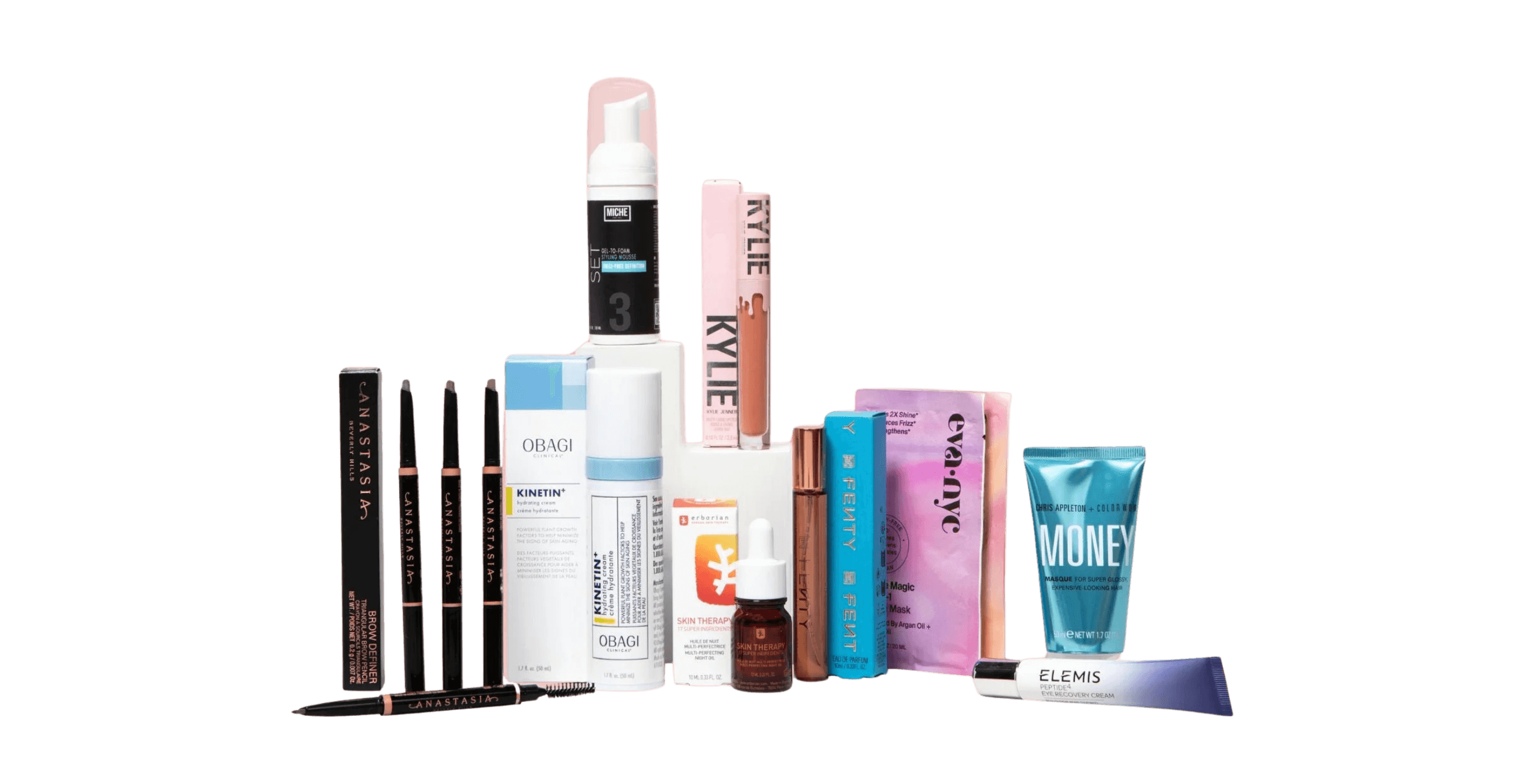
An estimated 70% of beauty products go unused, often due to unmet expectations or impulse purchases.
Many of these products are thrown away.
By encouraging customers to bring them in, the system creates an accessible alternative to waste—without requiring extra effort outside their normal shopping routine.
An estimated 70% of beauty products go unused, often due to unmet expectations or impulse purchases.
Many of these products are thrown away.
By encouraging customers to bring them in, the system creates an accessible alternative to waste—without requiring extra effort outside their normal shopping routine.
2.SCAN PRODUCTS INTO KIOSK
2.SCAN PRODUCTS
INTO KIOSK
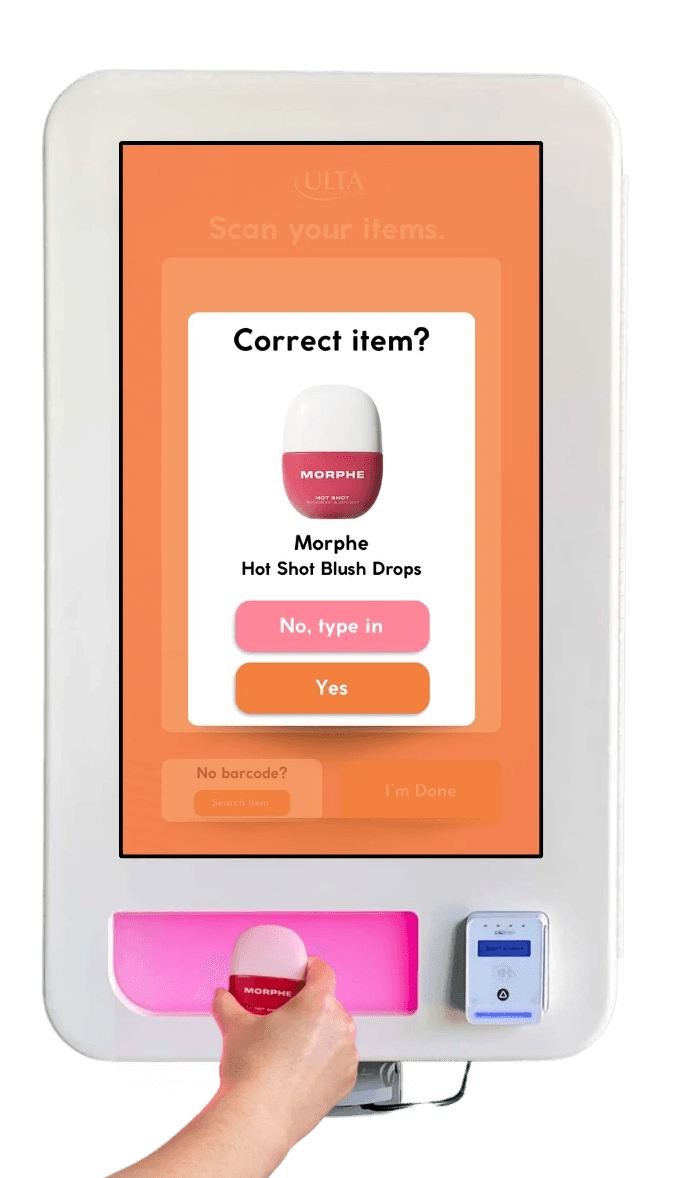
Users begin by scanning product barcodes at the kiosk.
If a barcode isn’t available, items can be manually searched by name, category, or brand—similar to looking up produce at a grocery store.
Each item is then confirmed to ensure accuracy and assign the correct value, building trust in the system.
Users begin by scanning product barcodes at the kiosk.
If a barcode isn’t available, items can be manually searched by name, category, or brand—similar to looking up produce at a grocery store.
Each item is then confirmed to ensure accuracy and assign the correct value, building trust in the system.
4.CHOOSE REWARDS
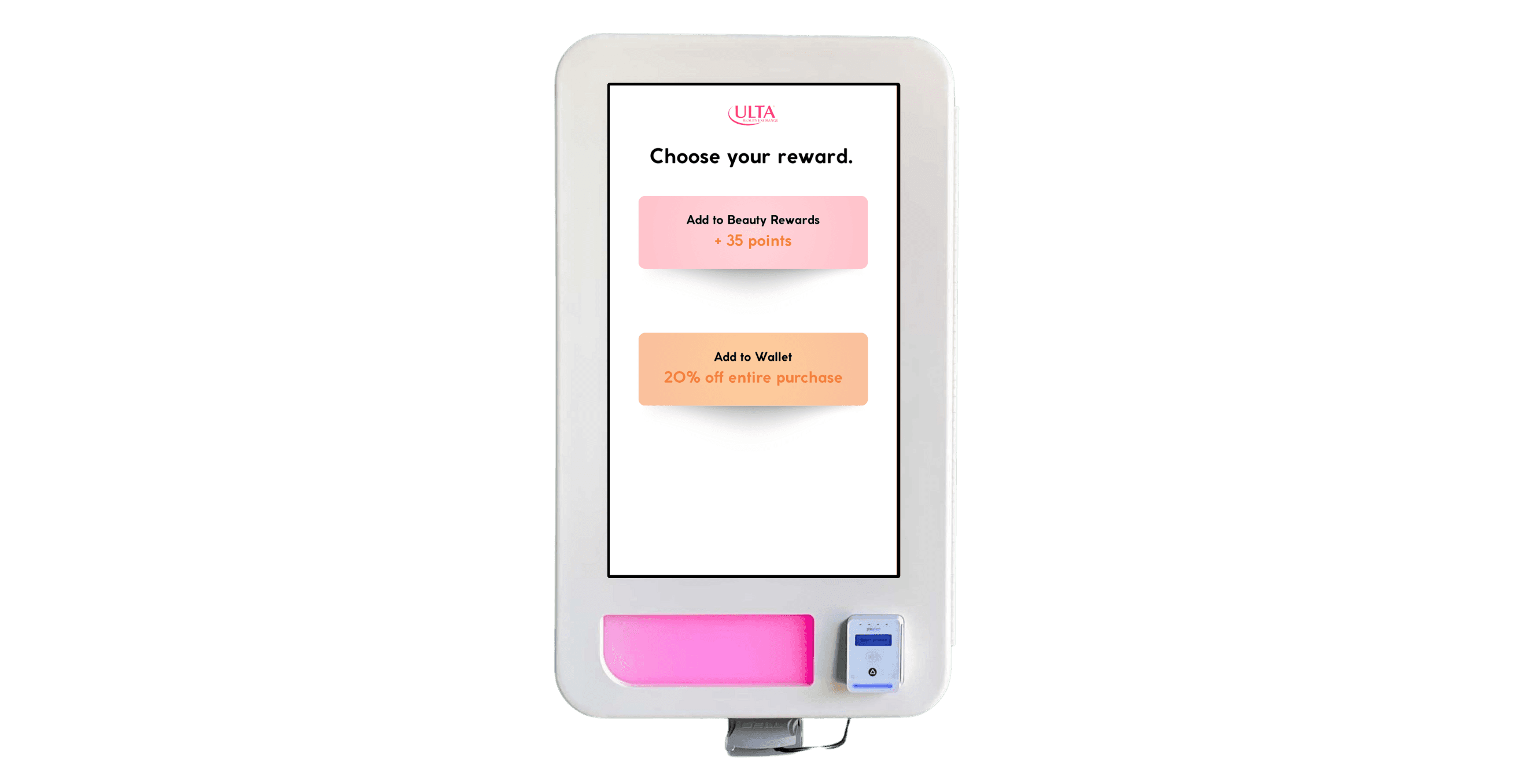
Users can either:
Add points directly to their Ulta Rewards account
Receive a coupon of equivalent value
This flexibility allows users to choose what feels most valuable in the moment.
After selecting a reward, items are deposited into the kiosk to complete the exchange.
3.REVIEW EXCHANGE
3.REVIEW EXCHANGE
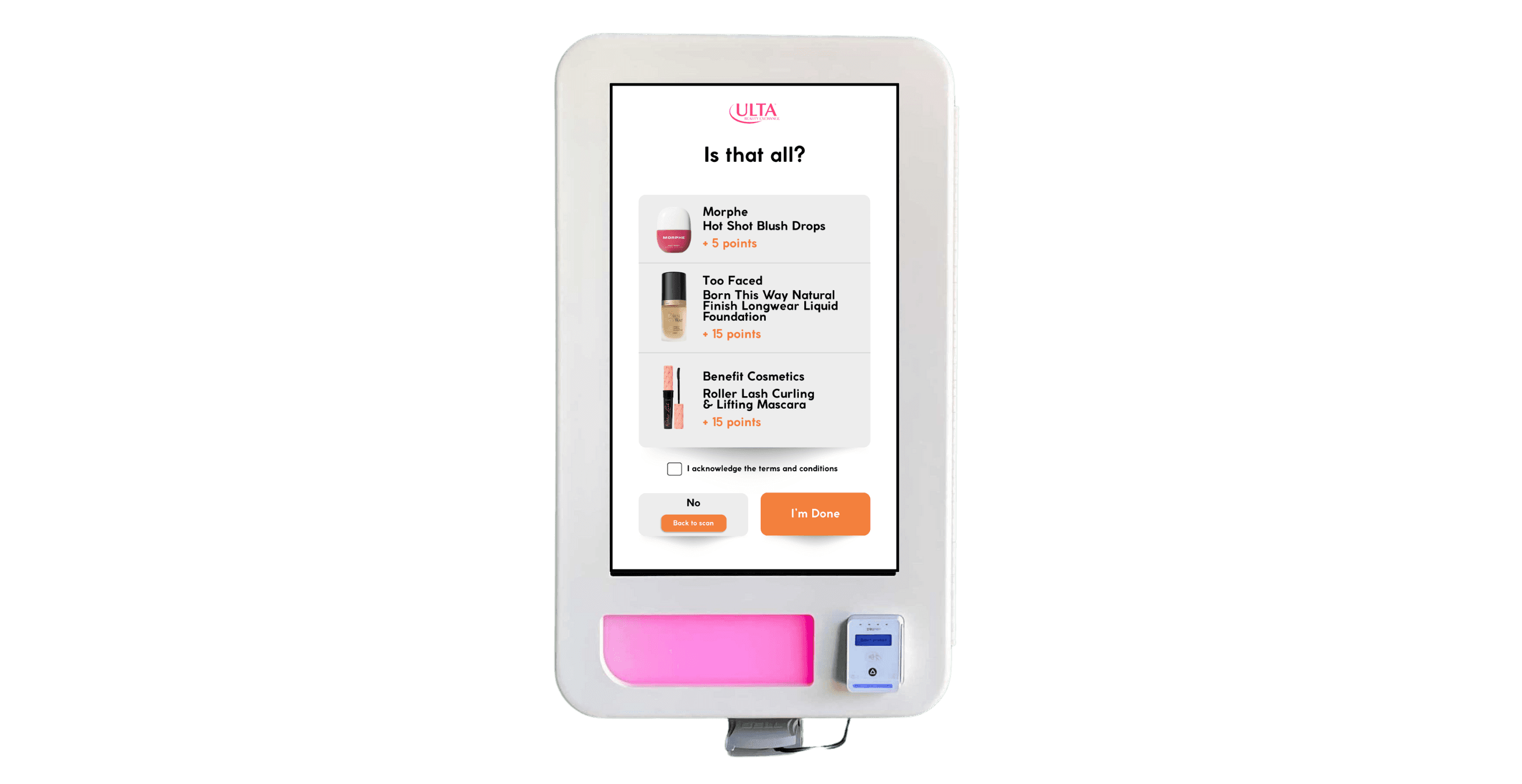
Users review the items they’ve entered and see the value translated into reward points.
Before proceeding, they confirm the details and acknowledge the terms—ensuring transparency in how value is calculated.
Users review the items they’ve entered and see the value translated into reward points.
Before proceeding, they confirm the details and acknowledge the terms—ensuring transparency in how value is calculated.
4.CHOOSE REWARDS
Users can either:
Add points directly to their Ulta Rewards account
Receive a coupon of equivalent value
This flexibility allows users to choose what feels most valuable in the moment.
After selecting a reward, items are deposited into the kiosk to complete the exchange.
REWARDS CAN BE USED SAME DAY
REWARDS CAN BE
USED SAME DAY
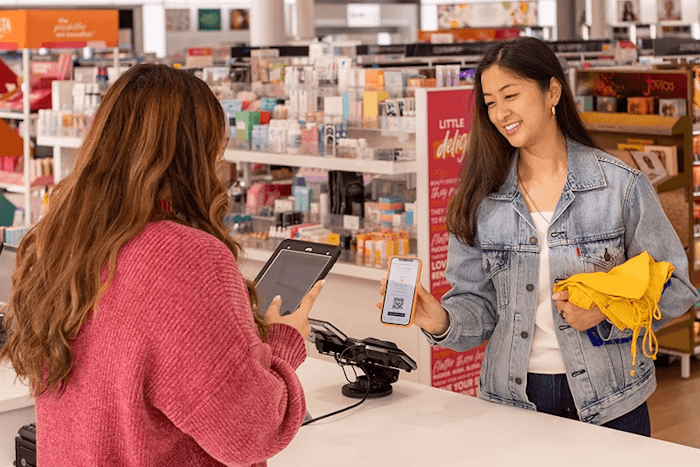
Rewards can be used immediately, reinforcing the behavior loop.
This creates a cycle where users are encouraged to return, engage, and continue participating—turning a one-time action into a repeatable habit.
Rewards can be used immediately, reinforcing the behavior loop.
This creates a cycle where users are encouraged to return, engage, and continue participating—turning a one-time action into a repeatable habit.
REFLECTIONS
REFLECTIONS
What This Project Represents
What This Project Represents
Customers are rewarded for unused products, while Ulta supports more sustainable consumption.
This project focused on designing a solution that balances user needs, business goals, and environmental impact.
It pushed me to think beyond a single interaction and consider the full system—how people behave, what motivates them, and how design can make better choices easier.
Customers are rewarded for unused products, while Ulta supports more sustainable consumption.
This project focused on designing a solution that balances user needs, business goals, and environmental impact.
It pushed me to think beyond a single interaction and consider the full system—how people behave, what motivates them, and how design can make better choices easier.